
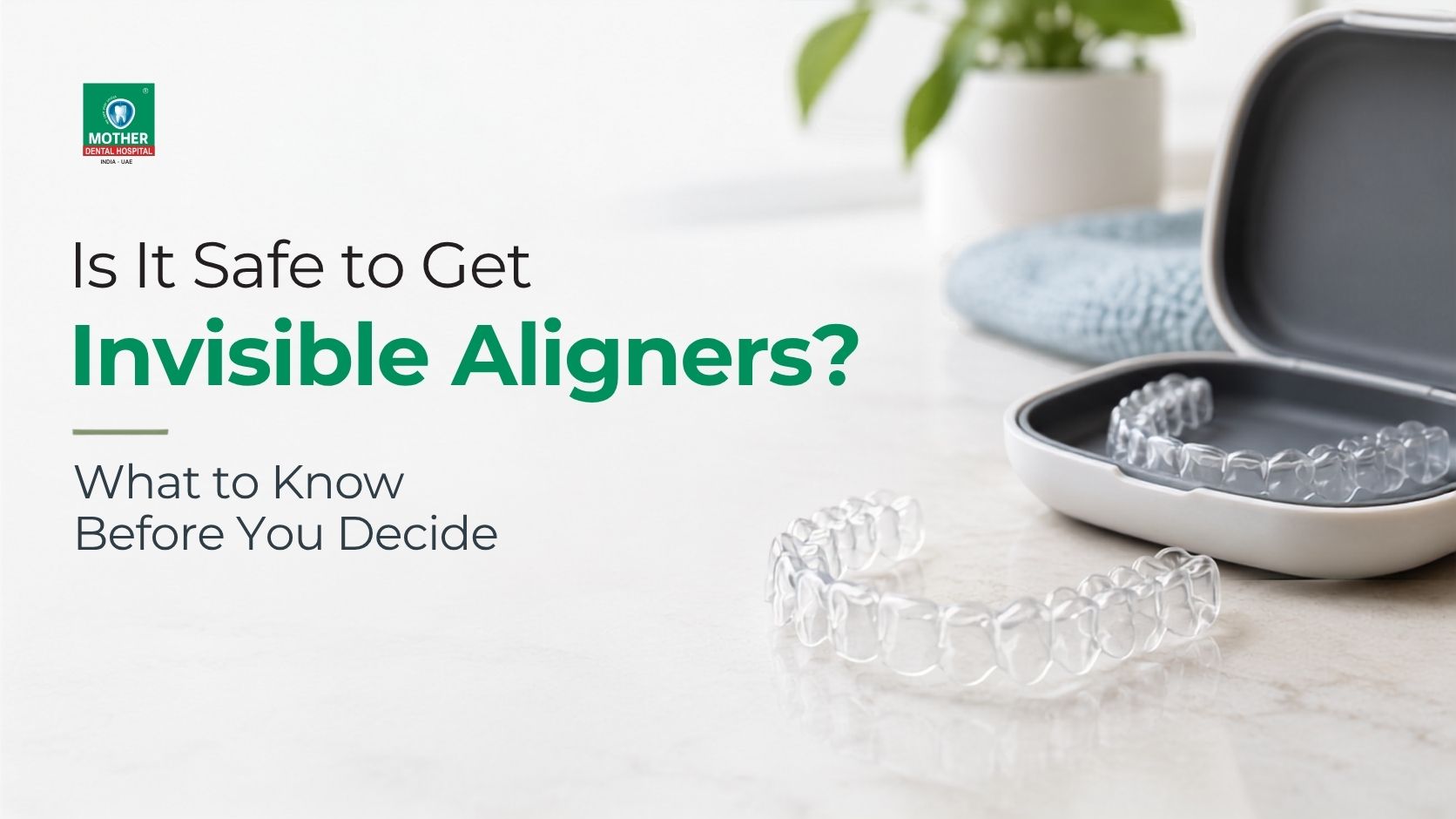
Is It Safe to Get Invisible Aligners? What to Know Before You Decide
Written By: Department of Orthodontics
Reviewed By: Specialist Dental Practitioner
Last Updated: September 2026 | Read Time: 5 mins
Yes, invisible aligners are safe. Despite their safety, these products aren’t for everyone.
They work well if your teeth have mild to moderate crowding, gaps, or minor bite issues. If your case is more complex, a bad bite, severely crooked teeth, or teeth that need to be rotated a lot braces usually still do a better job.
So the real question isn’t “are aligners safe.” It’s “am I the right kind of case for aligners.” That’s something a dentist needs to look at, not something you can guess from an ad or a review online.
Does it actually work? Is it better than braces?
Yes, aligners work for the right cases. They’re a good fit for spacing issues, mild crowding, and minor bite problems.
Where they fall short is severe crowding, a bad bite, or teeth that need a lot of movement. Braces handle those better because they apply constant, fixed pressure. Aligners depend on you wearing each tray as prescribed.
Neither one is “better” overall. Aligners win on looks and convenience. Braces win on handling harder cases without depending on you remembering to wear them. Your dentist should tell you which category your teeth fall into, not which one looks nicer in the brochure.
What results can you realistically expect?
22 hours a day, not “most of the time.”
Age isn’t really a barrier. Adults and teens both get good results, as long as their permanent teeth have fully come in. What matters more is how complex the case is and whether you’ll stick to wearing them.
On speed: aligners are often quicker for mild cases, sometimes 6 to 12 months. Braces can be faster for harder cases, since they don’t depend on you swapping trays on schedule. Which one is “faster” depends on what’s being fixed, not which technology is newer.
Is it painful? What's the worst part?
You’ll feel pressure, not the kind of sharp pain people associate with braces. Each time you switch to a new tray, expect some pressure for 2 to 3 days. That’s the tray doing its job. It fades on its own.
For most people, the hardest stretch is the first week of treatment. Overall, your mouth is still getting used to wearing a tray most of the day. After that, each new tray feels like a smaller version of that same adjustment. If you ever feel sharp pain instead of pressure, that’s not normal to call your dentist.
Can you eat with them on?
No. Take them out for all food, and for anything besides water. This isn’t a “try to remember” rule it’s a hard one. Eating with them can crack the tray or trap food against your teeth, which works against the treatment instead of helping it.
This is also where a lot of people struggle. Taking them out, cleaning them, and putting them back in several times a day sounds simple until it’s something you have to do consistently for months.
How much does 3 months of Invisalign cost in India?
Full Invisalign treatment in India generally costs somewhere between ₹80,000 and ₹4,50,000, depending on how complex your case is, how long treatment takes, and which city you’re in. There isn’t really a standalone “3 months” price Invisalign is usually billed as one package covering your full treatment plan, not broken into monthly chunks like a subscription.
For simpler, shorter cases (mild crowding or spacing, treated in a few months), costs tend to fall on the lower end of that range. Complex cases needing a year or more of treatment cost more, since more aligner sets and dentist visits are involved.
The best way to know your actual cost is a consultation and scan pricing depends entirely on your specific case, not a flat rate anyone can quote without seeing your teeth.
Why do some dentists not recommend Invisalign?
This deserves a straight answer, not a dodge. A few real reasons dentists sometimes steer patients away from aligners:
- The case is too complex: some bites genuinely need the fixed control that braces provide
- Aligners only work if you wear them as prescribed: a dentist can’t control what happens once you leave the clinic
- For some cases, braces get an equal or better result for less money
None of this means aligners are unsafe. It means they’re the wrong tool for certain jobs the same way a dentist wouldn’t recommend a filling when what you actually need is a root canal.
What's the failure rate?
“Failure” usually means one of two things: the bite didn’t fully correct, or the patient didn’t get the full result because they didn’t wear the aligners enough.
It’s rarely about the aligner itself. It almost always comes down to two things: was this the right treatment for this case, and did the patient actually wear it as prescribed. That’s exactly why a proper consultation and scan matter more than which brand of tray you choose.
Where to get proper aligner guidance in Kerala
Aligners work well only when the diagnosis behind them is right so where you get evaluated matters more than which aligner brand you pick.
At Mother Dental Hospital, aligner cases are assessed with a proper scan and consultation before any treatment is planned, not sold based on how a case looks in photos. We’ve placed over 10,000 invisible aligners and completed over 10,000 dental implants, so aligner planning here isn’t a side service, it’s something the team handles at volume, regularly.
With branches across Calicut, including Eranhipalam, you can get evaluated at whichever location is closest to you and continue your check-ins at the same branch throughout treatment.
If you’re unsure whether your case is a good fit for aligners or needs braces instead, that’s exactly the kind of question worth asking in a consultation rather than guessing from an article including this one.
Talk to a dentist before you decide
Invisible aligners are safe and effective for the right cases. Whether they’re right for you is a clinical decision, not a marketing one.
If you’re weighing aligners against braces, the first step isn’t picking a treatment, it’s getting a consultation and a scan so you know which case you actually have.