Dental Implants vs Dental Bridges: Which Is Better for Missing Teeth?
Written by: Fixed Restorative Treatment Department, Mother Dental Hospital
Last Updated: August 2026
Losing a tooth is more common than most people think It affects more than just how your smile looks.
A missing tooth leaves a gap, and over time the teeth around it start to shift, your bite changes, chewing gets harder on one side, and the jawbone under the empty space slowly starts to shrink from lack of use.
Left untreated for a few years, this can even change the shape of your face and make treatment more difficult and costly later on.
The good news is that two well-established treatments dental implants and dental bridges can both close that gap effectively.
The right choice for you depends on your budget, your age, how healthy your jawbone is, and how many teeth you’re replacing. This guide breaks down both options in simple terms so you know what to expect and what questions to ask before your dental visit.
What Happens When You Leave a Missing Tooth Space
When a tooth is lost and not replaced, a few things tend to happen over time:
- Bone loss – the jawbone under a missing tooth needs the pressure of chewing to stay strong. Without it, the bone slowly shrinks, research shows nearly 50% of the alveolar bone width can be lost within the first 12 months after a tooth is gone, which can later make it harder to fit an implant or denture properly.
- Shifting teeth – the teeth next to the gap tend to tilt into the empty space, and the tooth above or below it can grow slightly longer, throwing off your bite.
- Chewing and speech changes – chewing becomes harder, especially on that side, and speech can be affected too, especially if it’s a front tooth.
This is why dentists usually recommend replacing a missing tooth within a few months instead of waiting.
The longer you wait, the more it can end up costing to fix.
Related read: what to do and avoid after a tooth extraction.
What Is a Dental Bridge?
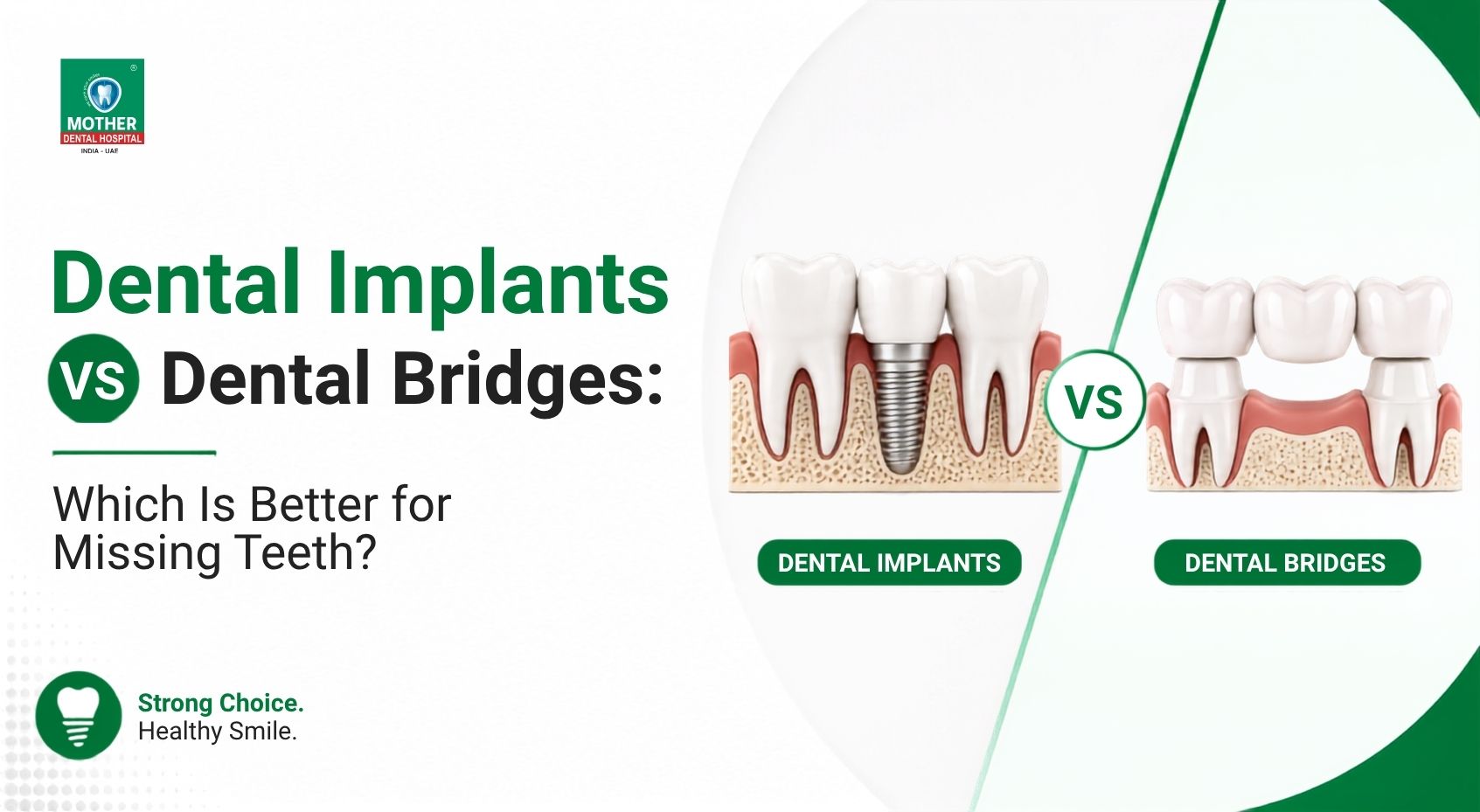
A dental bridge is a fixed replacement tooth that “bridges” the gap left by one or more missing teeth. It’s made up of an artificial tooth held in place by crowns fitted on the natural teeth on either side of the gap. It’s one of the treatment options covered under our crowns, bridges, and implants services
Types of bridges:
- Traditional bridge – the most common type; crowns go on the teeth on both sides of the gap to hold the artificial tooth in place.
- Cantilever bridge – held in place by a tooth on just one side, used when there’s only one tooth next to the gap.
- Maryland bridge – uses a thin metal or porcelain wing bonded to the back of the neighbouring teeth instead of full crowns; a more conservative option.
- Implant-supported bridge – held up by dental implants instead of your natural teeth, used to replace several missing teeth without touching your remaining teeth.
A bridge stays fixed in your mouth you don’t take it out like a denture. Most types don’t require surgery, since they’re anchored to your natural teeth rather than placed into the bone, and treatment is usually done in two to three visits.
Materials Matter: PFM vs. All-Ceramic & Zirconia
Bridges and implants use custom-made crowns to replicate your natural teeth, but the materials used determine both their durability and appearance:
Porcelain-Fused-to-Metal (PFM): Strong and budget-friendly. Over time, though, a thin dark line can show up along the gumline if your gums pull back a little.
Zirconia / All-Ceramic: Highly durable, tooth-colored, and completely metal-free. It blends in naturally with your other teeth, which makes it a popular choice for front teeth and long-lasting bridges.
What Is a Dental Implant?
A dental implant replaces both the root and the visible part of a missing tooth. A small titanium (or zirconia) post is placed into the jawbone through a minor surgery. Over a few months, the bone grows around the post and holds it firmly in place; this is called osseointegration. Once that’s healed, a crown is fitted on top.
Because it replaces the root as well as the tooth itself, an implant is the only option that also helps stop the bone loss that follows tooth loss.
The full process usually takes anywhere from 2 to 6 months from placement to the final crown, depending on how fast you heal, though faster options exist for some cases. It takes more time than a bridge, but it ends up feeling and working the closest to a real tooth.
Dental Implants vs Dental Bridges: Side-by-Side Comparison
| Factor | Dental Bridge | Dental Implant |
|---|---|---|
| Procedure | No surgery (traditional/Maryland) | Minor surgery |
| Treatment time | 2–3 weeks, few visits | 2–6 months (healing + crown) |
| Lifespan | 5–15 years on average | 20–25+ years, often a lifetime with care |
| Effect on nearby teeth | Nearby teeth get filed down for crowns | Nearby teeth aren’t touched |
| Bone health | Doesn’t stop bone loss | Keeps the jawbone strong |
| Upfront cost | Lower | Higher |
| Long-term cost | May need replacing every 5–15 years | Higher upfront, but fewer replacements over time |
| Best for | Multiple teeth in a row, limited bone, faster timeline | Single or multiple gaps with healthy bone, long-term use |
Advantages of Dental Implants
- Lasts much longer – with good care, implants can last decades, often a lifetime, while bridges usually need replacing every 5-15 years.
- Keeps your jawbone healthy – the titanium root does the same job a natural tooth root does, so it helps stop the bone from shrinking.
- Doesn’t touch your other teeth – unlike a bridge, no healthy teeth need to be filed down.
- Feels closest to a real tooth – implants stand on their own in the jaw, so biting and chewing feel more natural.
- Can’t get a cavity – since it’s titanium, the implant itself can’t decay (though you still need to keep the gum around it clean).
- Works for many situations – one implant, several implants, or an implant-supported bridge/denture can replace anywhere from one tooth to a full set.
Read more in our guide on the long-term benefits of dental implants.
Advantages of Dental Bridges
- Faster – no surgery, no healing time; usually done in two to three visits.
- Costs less upfront – a real factor for many people, especially on a tighter budget.
- No surgery needed – a better fit for people who can’t or don’t want to go through a surgical procedure.
- Tried and tested – bridges have been used for decades with predictable, reliable results.
Which Is Better by Age Group?
Age itself isn’t a strict rule, but it’s closely linked to bone health, healing ability, and daily needs all of which matter for this decision.
Younger adults (20s–40s) with healthy bone: Implants are usually the better long-term pick here. A younger patient will likely live with this tooth replacement for 30–50 years, and an implant’s longer lifespan and bone-preserving benefits make it more worth the cost over that stretch of time, even though it costs more upfront.
Middle-aged adults (40s–60s): Either option can work well. The decision often comes down to bone density, whether the nearby teeth already have large fillings or crowns (which can make a bridge more practical, since those teeth may need crowns anyway), and budget.
Older adults (60s+): Here, overall health matters more than age itself. Conditions like osteoporosis, uncontrolled diabetes, or certain medicines can make healing after implant surgery harder. Bone also naturally thins with age, sometimes requiring a bone graft before an implant can be placed. In these cases, a bridge (or an implant-supported denture for multiple missing teeth) may be the more practical route. That said, healthy, non-smoking older adults with enough bone are often still great candidates for implants — age alone shouldn’t rule it out without a proper check-up.
Children and teens: Implants are usually avoided until the jaw has fully finished growing, since an implant doesn’t move with the jaw the way natural teeth do. A space maintainer or temporary option is used instead until the jaw is fully grown.
Dental Implant vs Bridge Cost: What to Expect
Cost is usually what tips the decision once both options are clinically possible. In general:
- A single dental implant (post, abutment, and crown together) costs more upfront than a bridge, mainly because of the surgery, the implant material, and the follow-up visits involved.
- A traditional 3-unit bridge usually costs less to start with, since there’s no surgery but keep in mind it will likely need replacing once, maybe twice, over your lifetime, while a well-cared-for implant often doesn’t.
- Insurance and financing in India varies by provider. Many clinics, including ours, offer EMI options to make either treatment easier on your budget, so cost alone shouldn’t be the only thing deciding this for you.
For an accurate, personal cost estimate for implants or bridges in Kochi, Kannur, or Thrissur, it’s best to come in for a check-up. Your X-rays and bone health affect the final price more than any general number can tell you. See our affordable dental implants guide for more on what affects implant pricing.
Dental Implant vs Bridge Cost in Kerala: Transparency & Financing
While exact costs depend on your individual 3D X-rays and bone health, understanding standard price ranges in India helps you plan your budget effectively:
- Traditional 3-Unit Bridge: ₹9,000 – ₹25,000+ total (influenced by material choice like PFM vs. Zirconia, and the number of missing tooth units)
- Single Dental Implant (complete with post & crown): ₹20,000 – ₹45,000+ per tooth (influenced by implant system brand, custom abutment type, and crown material)
- Bone Grafting / Sinus Lift (if needed): ₹5,000 – ₹15,000 extra (influenced by the volume of graft material required)
Prices above are indicative and may vary by branch. Please confirm exact costs during your consultation, based on your X-rays and treatment plan.
Other Options If Neither Fits
- Partial dentures — removable, cheaper, but not as stable or comfortable as a fixed bridge or implant. Often used when someone isn’t ready for or can’t yet afford a permanent solution.
- Space maintainers — mainly used for children, to hold space for permanent teeth to come in, or as a short-term fix before a permanent solution.
How We Help You Decide at Mother Dental Hospital
Every case is different, and the “better” option really depends on what’s going on in your mouth, not just a general list of pros and cons. At Mother Dental Hospital, here’s how we approach missing tooth cases:
- A thorough check-up and imaging to look at your bone density and the condition of nearby teeth before recommending either option
- Honest guidance on cost, timeline, and upkeep for both treatments — including telling you when a bridge is genuinely the better fit for your case, not just the cheaper one
- Experienced restorative and implant care through our fixed restorative treatment services, covering both crowns/bridges and implant placement
- Follow-up visits after treatment to make sure everything is healing and working the way it should, whichever option you go with
We’ve treated patients across a wide age range from adults needing a single tooth replaced after an extraction, to older patients needing several teeth restored and our team walks you through the reasoning behind our recommendation, not just the price.
Frequently Asked Questions
Is a dental implant or bridge better for a front tooth?
Both can look natural, but implants usually keep their look and gum shape better over time since they don’t need nearby teeth filed down. For a visible front tooth, many dentists prefer implants when bone health allows it, but a well-made bridge can also look great.
How long does a dental bridge last compared to an implant?
A bridge usually lasts 5–15 years before it needs replacing. An implant, with proper care, can last 20–25 years or longer — often a lifetime.
Can a dental bridge be replaced with an implant later?
Yes. It’s common for people to start with a bridge and switch to an implant later, though the bone and gum condition at that time will decide if it’s possible.
Are dental implants painful?
The procedure is done under local anaesthesia, so you shouldn’t feel pain during it. Some soreness and swelling for a few days afterward is normal and can be managed with regular pain relief.
Is a bridge or implant better if I have diabetes?
It depends on how well your diabetes is managed. Well-controlled diabetes doesn’t rule out implants, but poorly controlled blood sugar can slow healing, in which case a bridge might be recommended instead. Your dentist will check this on a case-by-case basis.
Do dental bridges damage the teeth next to them?
The teeth on either side need to be filed down to hold the crowns, which permanently changes them. If those teeth are otherwise healthy, this is a real trade-off to weigh against the bridge’s lower cost and quicker timeline.
Which Should You Choose?
If you want the option that keeps your jawbone healthiest and you’re in good overall health, a dental implant is usually the better long-term choice. If you want something faster and cheaper, or you have health or bone limits that make surgery harder, a bridge remains a solid, well-tested option.
The only real way to know for sure is a proper check-up your X-rays, bone health, and the condition of your nearby teeth all matter for the right choice in your case. Book a consultation with Mother Dental Hospital and we’ll help you figure out the best option for your smile, honestly and without any pressure.